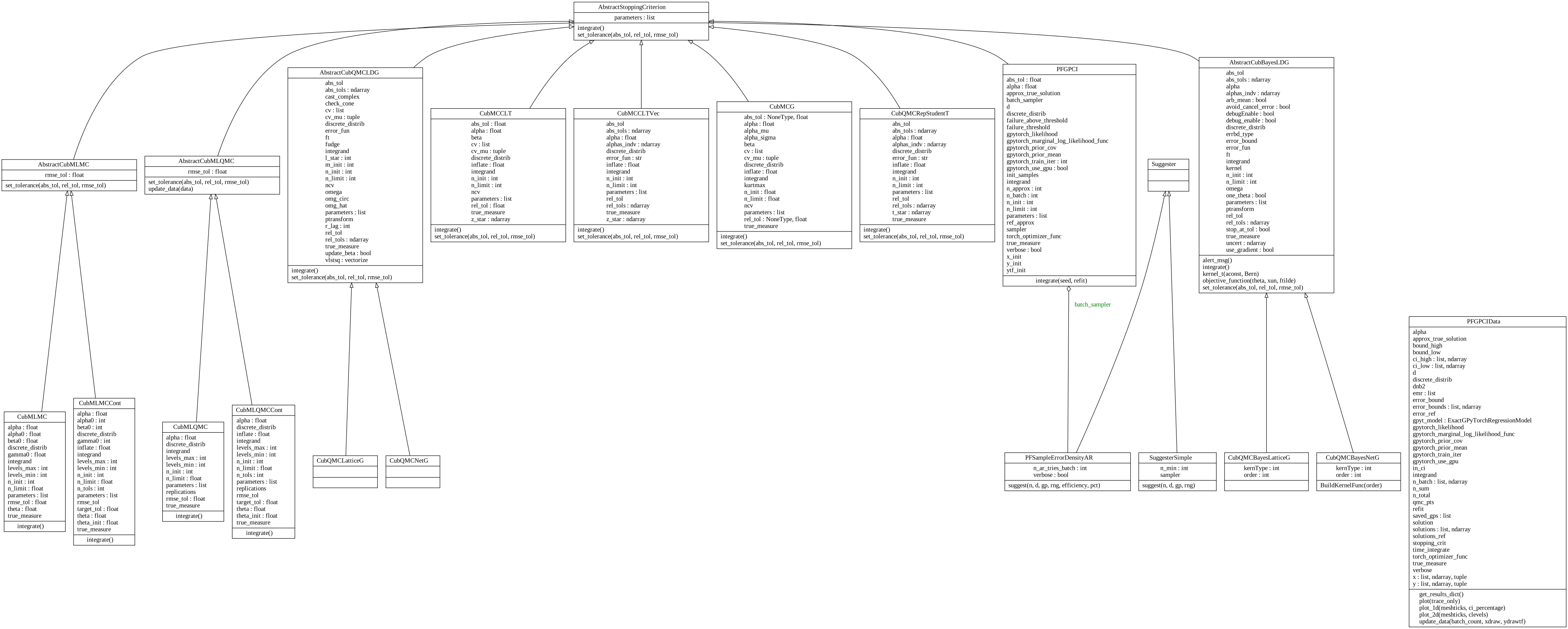
Stopping Criteria
UML Overview

AbstractStoppingCriterion
Bases: object
Initialize a stopping criterion base class.
Parameters:
| Name | Type | Description | Default |
|---|---|---|---|
allowed_distribs
|
list
|
Allowed discrete distribution classes. |
required |
allow_vectorized_integrals
|
bool
|
Whether to allow integrands with
vectorized outputs, meaning |
required |
Source code in qmcpy/stopping_criterion/abstract_stopping_criterion.py
integrate
Determine the samples needed to satisfy the target tolerance.
Parameters:
| Name | Type | Description | Default |
|---|---|---|---|
resume
|
Data
|
Existing integration state to resume from, if supported. A valid resume checkpoint must continue the same numerical experiment without duplicating samples, losing accumulated statistics, or weakening the requested tolerance guarantee. Supported resume implementations validate and copy the checkpoint before mutating any state so the caller's saved object is preserved. Defaults to None. |
None
|
Returns:
| Type | Description |
|---|---|
tuple
|
tuple[Union[float, np.ndarray], Data]: Approximation to the integral
with shape |
Source code in qmcpy/stopping_criterion/abstract_stopping_criterion.py
get_iteration_log
get_iteration_log(history=None, printed_only=True, drop_empty_columns=True, formatted=True, view='all')
Return the latest iteration log as a pandas DataFrame.
Parameters:
| Name | Type | Description | Default |
|---|---|---|---|
history
|
list[dict] | None
|
Iteration history to format. If |
None
|
printed_only
|
bool
|
If |
True
|
drop_empty_columns
|
bool
|
If |
True
|
formatted
|
bool
|
If |
True
|
view
|
str
|
Which log view to return. |
'all'
|
Returns:
| Type | Description |
|---|---|
DataFrame
|
pandas.DataFrame: DataFrame representation of the iteration log. |
Source code in qmcpy/stopping_criterion/abstract_stopping_criterion.py
format_iteration_log
Return the iteration log as formatted text.
Parameters:
| Name | Type | Description | Default |
|---|---|---|---|
history
|
IterationHistoryTable | None
|
Iteration history
to format. If |
None
|
printed_only
|
bool
|
If |
True
|
include_header
|
bool
|
If |
True
|
Returns:
| Name | Type | Description |
|---|---|---|
str |
str
|
Formatted iteration log text. |
Source code in qmcpy/stopping_criterion/abstract_stopping_criterion.py
print_iteration_log
Print the iteration log for the latest run or supplied history.
Parameters:
| Name | Type | Description | Default |
|---|---|---|---|
history
|
IterationHistoryTable | None
|
Iteration history
to print. If |
None
|
printed_only
|
bool
|
If |
True
|
include_header
|
bool
|
If |
True
|
file
|
TextIO | None
|
Output stream. Defaults to
|
None
|
Returns:
| Name | Type | Description |
|---|---|---|
None |
None
|
This method writes output to |
Source code in qmcpy/stopping_criterion/abstract_stopping_criterion.py
set_tolerance
Reset the tolerances.
Parameters:
| Name | Type | Description | Default |
|---|---|---|---|
abs_tol
|
float
|
Absolute tolerance, when supported. If supplied, reset it; otherwise ignore it. |
None
|
rel_tol
|
float
|
Relative tolerance, when supported. If supplied, reset it; otherwise ignore it. |
None
|
rmse_tol
|
float
|
RMSE tolerance, when supported. If supplied,
reset it; otherwise ignore it. If |
None
|
Source code in qmcpy/stopping_criterion/abstract_stopping_criterion.py
QMC
CubQMCNetG
Bases: AbstractCubQMCLDG
Quasi-Monte Carlo stopping criterion using digital net cubature with guarantees for cones of functions with a predictable decay in the Walsh coefficients.
Examples:
>>> k = Keister(DigitalNetB2(seed=7))
>>> sc = CubQMCNetG(k,abs_tol=1e-3,rel_tol=0,check_cone=True)
>>> solution,data = sc.integrate()
>>> solution
array(1.38046669)
>>> data
Data (Data)
    solution        1.380
    comb_bound_low  1.380
    comb_bound_high 1.381
    comb_bound_diff 6.72e-04
    comb_flags      1
    n_total         2^(11)
    n               2^(11)
    time_integrate  ...
CubQMCNetG (AbstractStoppingCriterion)
    abs_tol         0.001
    rel_tol         0
    n_init          2^(10)
    n_limit         2^(35)
Keister (AbstractIntegrand)
Gaussian (AbstractTrueMeasure)
    mean            0
    covariance      2^(-1)
    decomp_type     PCA
DigitalNetB2 (AbstractLDDiscreteDistribution)
    d               1
    replications    1
    randomize       LMS DS
    gen_mats_source joe_kuo.6.21201.txt
    order           RADICAL INVERSE
    t               63
    alpha           1
    n_limit         2^(32)
    entropy         7
Vector outputs
>>> f = BoxIntegral(DigitalNetB2(3,seed=7),s=[-1,1])
>>> abs_tol = 1e-3
>>> sc = CubQMCNetG(f,abs_tol=abs_tol,rel_tol=0,check_cone=True)
>>> solution,data = sc.integrate()
>>> solution
array([1.19003352, 0.96068403])
>>> data
Data (Data)
    solution        [1.19  0.961]
    comb_bound_low  [1.189 0.96 ]
    comb_bound_high [1.191 0.962]
    comb_bound_diff [0.001 0.002]
    comb_flags      [ True  True]
    n_total         2^(14)
    n               [16384  1024]
    time_integrate  ...
CubQMCNetG (AbstractStoppingCriterion)
    abs_tol         0.001
    rel_tol         0
    n_init          2^(10)
    n_limit         2^(35)
BoxIntegral (AbstractIntegrand)
    s               [-1  1]
Uniform (AbstractTrueMeasure)
    lower_bound     0
    upper_bound     1
DigitalNetB2 (AbstractLDDiscreteDistribution)
    d               3
    replications    1
    randomize       LMS DS
    gen_mats_source joe_kuo.6.21201.txt
    order           RADICAL INVERSE
    t               63
    alpha           1
    n_limit         2^(32)
    entropy         7
>>> sol3neg1 = -np.pi/4-1/2*np.log(2)+np.log(5+3*np.sqrt(3))
>>> sol31 = np.sqrt(3)/4+1/2*np.log(2+np.sqrt(3))-np.pi/24
>>> true_value = np.array([sol3neg1,sol31])
>>> assert (abs(true_value-solution)<abs_tol).all()
Sensitivity indices
>>> function = Genz(DigitalNetB2(3,seed=7))
>>> integrand = SensitivityIndices(function)
>>> sc = CubQMCNetG(integrand,abs_tol=5e-4,rel_tol=0,check_cone=True)
>>> solution,data = sc.integrate()
>>> data
Data (Data)
    solution        [[0.02  0.196 0.667]
                     [0.036 0.303 0.782]]
    comb_bound_low  [[0.019 0.195 0.667]
                     [0.035 0.303 0.781]]
    comb_bound_high [[0.02  0.196 0.667]
                     [0.036 0.303 0.782]]
    comb_bound_diff [[0.001 0.    0.001]
                     [0.001 0.001 0.001]]
    comb_flags      [[ True  True  True]
                     [ True  True  True]]
    n_total         2^(16)
    n               [[[16384 65536 65536]
                      [16384 65536 65536]
                      [16384 65536 65536]]

                     [[ 2048 16384 32768]
                      [ 2048 16384 32768]
                      [ 2048 16384 32768]]]
    time_integrate  ...
CubQMCNetG (AbstractStoppingCriterion)
    abs_tol         5.00e-04
    rel_tol         0
    n_init          2^(10)
    n_limit         2^(35)
SensitivityIndices (AbstractIntegrand)
    indices         [[ True False False]
                     [False  True False]
                     [False False  True]]
Uniform (AbstractTrueMeasure)
    lower_bound     0
    upper_bound     1
DigitalNetB2 (AbstractLDDiscreteDistribution)
    d               3
    replications    1
    randomize       LMS DS
    gen_mats_source joe_kuo.6.21201.txt
    order           RADICAL INVERSE
    t               63
    alpha           1
    n_limit         2^(32)
    entropy         7
Control Variates
>>> dnb2 = DigitalNetB2(dimension=4,seed=7)
>>> integrand = CustomFun(
...     true_measure = Uniform(dnb2),
...     g = lambda t: np.stack([
...         1*t[...,0]+2*t[...,0]**2+3*t[...,0]**3,
...         2*t[...,1]+3*t[...,1]**2+4*t[...,1]**3,
...         3*t[...,2]+4*t[...,2]**2+5*t[...,2]**3]),
...     dimension_indv = (3,))
>>> control_variates = [
...     CustomFun(
...         true_measure = Uniform(dnb2),
...         g = lambda t: np.stack([t[...,0],t[...,1],t[...,2]],axis=0),
...         dimension_indv = (3,)),
...     CustomFun(
...         true_measure = Uniform(dnb2),
...         g = lambda t: np.stack([t[...,0]**2,t[...,1]**2,t[...,2]**2],axis=0),
...         dimension_indv = (3,))]
>>> control_variate_means = np.array([[1/2,1/2,1/2],[1/3,1/3,1/3]])
>>> true_value = np.array([23/12,3,49/12])
>>> abs_tol = 1e-6
>>> sc = CubQMCNetG(integrand,abs_tol=abs_tol,rel_tol=0,control_variates=control_variates,control_variate_means=control_variate_means,update_cv_coeffs=False)
>>> solution,data = sc.integrate()
>>> solution
array([1.91666667, 3.        , 4.08333333])
>>> data.n
array([ 8192,  8192, 16384])
>>> assert (np.abs(true_value-solution)<abs_tol).all()
>>> sc = CubQMCNetG(integrand,abs_tol=abs_tol,rel_tol=0,control_variates=control_variates,control_variate_means=control_variate_means,update_cv_coeffs=True)
>>> solution,data = sc.integrate()
>>> solution
array([1.91666667, 3.        , 4.08333333])
>>> data.n
array([16384, 16384, 16384])
>>> assert (np.abs(true_value-solution)<abs_tol).all()
References:
-
Hickernell, Fred J., and Lluís Antoni Jiménez Rugama. "Reliable adaptive cubature using digital sequences." Monte Carlo and Quasi-Monte Carlo Methods: MCQMC, Leuven, Belgium, April 2014. Springer International Publishing, 2016.
-
Sou-Cheng T. Choi, Yuhan Ding, Fred J. Hickernell, Lan Jiang, Lluis Antoni Jimenez Rugama, Da Li, Jagadeeswaran Rathinavel, Xin Tong, Kan Zhang, Yizhi Zhang, and Xuan Zhou, GAIL: Guaranteed Automatic Integration Library (Version 2.3) [MATLAB Software], 2019. http://gailgithub.github.io/GAIL_Dev/. https://github.com/GailGithub/GAIL_Dev/blob/master/Algorithms/IntegrationExpectation/cubSobol_g.m.
Parameters:
| Name | Type | Description | Default |
|---|---|---|---|
integrand
|
AbstractIntegrand
|
The integrand. |
required |
abs_tol
|
ndarray
|
Absolute error tolerance. |
0.01
|
rel_tol
|
ndarray
|
Relative error tolerance. |
0.0
|
n_init
|
int
|
Initial number of samples. |
2 ** 10
|
n_limit
|
int
|
Maximum number of samples. |
2 ** 35
|
error_fun
|
Union[str, callable]
|
Function mapping the approximate solution, absolute error tolerance, and relative error tolerance to the current error bound.
|
'EITHER'
|
fudge
|
function
|
Positive function multiplying the finite sum of the Fourier coefficients specified in the cone of functions. |
_default_fudge
|
check_cone
|
bool
|
Whether or not to check if the function falls in the cone. |
False
|
control_variates
|
list
|
Integrands to use as control variates, each with the same underlying discrete distribution instance. |
None
|
control_variate_means
|
ndarray
|
Means of each control variate. |
None
|
update_cv_coeffs
|
bool
|
If set to true, the control variate coefficients are recomputed at each iteration. Otherwise they are estimated once after the initial sampling and then fixed. |
False
|
Source code in qmcpy/stopping_criterion/cub_qmc_net_g.py
CubQMCLatticeG
Bases: AbstractCubQMCLDG
Quasi-Monte Carlo stopping criterion using rank-1 lattice cubature with guarantees for cones of functions with a predictable decay in the Fourier coefficients.
Examples:
>>> k = Keister(Lattice(seed=7))
>>> sc = CubQMCLatticeG(k,abs_tol=1e-3,rel_tol=0,check_cone=True)
>>> solution,data = sc.integrate()
>>> solution
array(1.38037385)
>>> data
Data (Data)
    solution        1.380
    comb_bound_low  1.380
    comb_bound_high 1.381
    comb_bound_diff 0.001
    comb_flags      1
    n_total         2^(11)
    n               2^(11)
    time_integrate  ...
CubQMCLatticeG (AbstractStoppingCriterion)
    abs_tol         0.001
    rel_tol         0
    n_init          2^(10)
    n_limit         2^(30)
Keister (AbstractIntegrand)
Gaussian (AbstractTrueMeasure)
    mean            0
    covariance      2^(-1)
    decomp_type     PCA
Lattice (AbstractLDDiscreteDistribution)
    d               1
    replications    1
    randomize       SHIFT
    gen_vec_source  kuo.lattice-33002-1024-1048576.9125.txt
    order           RADICAL INVERSE
    n_limit         2^(20)
    entropy         7
Vector outputs
>>> f = BoxIntegral(Lattice(3,seed=11),s=[-1,1])
>>> abs_tol = 1e-3
>>> sc = CubQMCLatticeG(f,abs_tol=abs_tol,rel_tol=0,check_cone=True)
>>> solution,data = sc.integrate()
>>> solution
array([1.18947477, 0.96060862])
>>> data
Data (Data)
    solution        [1.189 0.961]
    comb_bound_low  [1.189 0.96 ]
    comb_bound_high [1.19  0.961]
    comb_bound_diff [0.001 0.001]
    comb_flags      [ True  True]
    n_total         2^(13)
    n               [8192 1024]
    time_integrate  ...
CubQMCLatticeG (AbstractStoppingCriterion)
    abs_tol         0.001
    rel_tol         0
    n_init          2^(10)
    n_limit         2^(30)
BoxIntegral (AbstractIntegrand)
    s               [-1  1]
Uniform (AbstractTrueMeasure)
    lower_bound     0
    upper_bound     1
Lattice (AbstractLDDiscreteDistribution)
    d               3
    replications    1
    randomize       SHIFT
    gen_vec_source  kuo.lattice-33002-1024-1048576.9125.txt
    order           RADICAL INVERSE
    n_limit         2^(20)
    entropy         11
>>> sol3neg1 = -np.pi/4-1/2*np.log(2)+np.log(5+3*np.sqrt(3))
>>> sol31 = np.sqrt(3)/4+1/2*np.log(2+np.sqrt(3))-np.pi/24
>>> true_value = np.array([sol3neg1,sol31])
>>> assert (abs(true_value-solution)<abs_tol).all()
Sensitivity indices
>>> function = Genz(Lattice(3,seed=7))
>>> integrand = SensitivityIndices(function)
>>> sc = CubQMCLatticeG(integrand,abs_tol=5e-4,rel_tol=0,check_cone=True)
>>> solution,data = sc.integrate()
>>> data
Data (Data)
    solution        [[0.021 0.196 0.667]
                     [0.036 0.303 0.782]]
    comb_bound_low  [[0.02  0.196 0.667]
                     [0.035 0.303 0.781]]
    comb_bound_high [[0.021 0.196 0.667]
                     [0.036 0.303 0.782]]
    comb_bound_diff [[0.001 0.001 0.   ]
                     [0.001 0.001 0.001]]
    comb_flags      [[ True  True  True]
                     [ True  True  True]]
    n_total         2^(16)
    n               [[[16384 32768 65536]
                      [16384 32768 65536]
                      [16384 32768 65536]]

                     [[ 2048 16384 32768]
                      [ 2048 16384 32768]
                      [ 2048 16384 32768]]]
    time_integrate  ...
CubQMCLatticeG (AbstractStoppingCriterion)
    abs_tol         5.00e-04
    rel_tol         0
    n_init          2^(10)
    n_limit         2^(30)
SensitivityIndices (AbstractIntegrand)
    indices         [[ True False False]
                     [False  True False]
                     [False False  True]]
Uniform (AbstractTrueMeasure)
    lower_bound     0
    upper_bound     1
Lattice (AbstractLDDiscreteDistribution)
    d               3
    replications    1
    randomize       SHIFT
    gen_vec_source  kuo.lattice-33002-1024-1048576.9125.txt
    order           RADICAL INVERSE
    n_limit         2^(20)
    entropy         7
References:
-
Lluis Antoni Jimenez Rugama and Fred J. Hickernell. "Adaptive multidimensional integration based on rank-1 lattices," Monte Carlo and Quasi-Monte Carlo Methods: MCQMC, Leuven, Belgium, April 2014 (R. Cools and D. Nuyens, eds.), Springer Proceedings in Mathematics. and Statistics, vol. 163, Springer-Verlag, Berlin, 2016, arXiv:1411.1966, pp. 407-422.
-
Sou-Cheng T. Choi, Yuhan Ding, Fred J. Hickernell, Lan Jiang, Lluis Antoni Jimenez Rugama, Da Li, Jagadeeswaran Rathinavel, Xin Tong, Kan Zhang, Yizhi Zhang, and Xuan Zhou, GAIL: Guaranteed Automatic Integration Library (Version 2.3) [MATLAB Software], 2019. http://gailgithub.github.io/GAIL_Dev/. https://github.com/GailGithub/GAIL_Dev/blob/master/Algorithms/IntegrationExpectation/cubLattice_g.m.
Parameters:
| Name | Type | Description | Default |
|---|---|---|---|
integrand
|
AbstractIntegrand
|
The integrand. |
required |
abs_tol
|
ndarray
|
Absolute error tolerance. |
0.01
|
rel_tol
|
ndarray
|
Relative error tolerance. |
0.0
|
n_init
|
int
|
Initial number of samples. |
2 ** 10
|
n_limit
|
int
|
Maximum number of samples. |
2 ** 30
|
error_fun
|
Union[str, callable]
|
Function mapping the approximate solution, absolute error tolerance, and relative error tolerance to the current error bound.
|
'EITHER'
|
fudge
|
function
|
Positive function multiplying the finite sum of the Fourier coefficients specified in the cone of functions. |
_default_fudge
|
check_cone
|
bool
|
Whether or not to check if the function falls in the cone. |
False
|
ptransform
|
str
|
Periodization transform, see the options in |
'BAKER'
|
Source code in qmcpy/stopping_criterion/cub_qmc_lattice_g.py
CubQMCBayesNetG
Bases: AbstractCubBayesLDG
Quasi-Monte Carlo stopping criterion using fast Bayesian cubature and digital nets with guarantees for Gaussian processes having certain digitally shift invariant kernels.
Examples:
>>> k = Keister(DigitalNetB2(2, seed=123456789))
>>> sc = CubQMCBayesNetG(k,abs_tol=5e-3)
>>> solution,data = sc.integrate()
>>> data
Data (Data)
    solution        1.809
    comb_bound_low  1.807
    comb_bound_high 1.810
    comb_bound_diff 0.003
    comb_flags      1
    n_total         2^(10)
    n               2^(10)
    time_integrate  ...
CubQMCBayesNetG (AbstractStoppingCriterion)
    abs_tol         0.005
    rel_tol         0
    n_init          2^(8)
    n_limit         2^(22)
    order           1
Keister (AbstractIntegrand)
Gaussian (AbstractTrueMeasure)
    mean            0
    covariance      2^(-1)
    decomp_type     PCA
DigitalNetB2 (AbstractLDDiscreteDistribution)
    d               2^(1)
    replications    1
    randomize       LMS DS
    gen_mats_source joe_kuo.6.21201.txt
    order           RADICAL INVERSE
    t               63
    alpha           1
    n_limit         2^(32)
    entropy         123456789
Vector outputs
>>> f = BoxIntegral(DigitalNetB2(3,seed=7),s=[-1,1])
>>> abs_tol = 1e-2
>>> sc = CubQMCBayesNetG(f,abs_tol=abs_tol,rel_tol=0)
>>> solution,data = sc.integrate()
>>> solution
array([1.18750491, 0.96076395])
>>> data
Data (Data)
    solution        [1.188 0.961]
    comb_bound_low  [1.18 0.96]
    comb_bound_high [1.195 0.962]
    comb_bound_diff [0.014 0.002]
    comb_flags      [ True  True]
    n_total         2^(11)
    n               [2048  256]
    time_integrate  ...
CubQMCBayesNetG (AbstractStoppingCriterion)
    abs_tol         0.010
    rel_tol         0
    n_init          2^(8)
    n_limit         2^(22)
    order           1
BoxIntegral (AbstractIntegrand)
    s               [-1  1]
Uniform (AbstractTrueMeasure)
    lower_bound     0
    upper_bound     1
DigitalNetB2 (AbstractLDDiscreteDistribution)
    d               3
    replications    1
    randomize       LMS DS
    gen_mats_source joe_kuo.6.21201.txt
    order           RADICAL INVERSE
    t               63
    alpha           1
    n_limit         2^(32)
    entropy         7
>>> sol3neg1 = -np.pi/4-1/2*np.log(2)+np.log(5+3*np.sqrt(3))
>>> sol31 = np.sqrt(3)/4+1/2*np.log(2+np.sqrt(3))-np.pi/24
>>> true_value = np.array([sol3neg1,sol31])
>>> assert (abs(true_value-solution)<abs_tol).all()
Sensitivity indices
>>> function = Genz(DigitalNetB2(3,seed=7))
>>> integrand = SensitivityIndices(function)
>>> sc = CubQMCBayesNetG(integrand,abs_tol=5e-2,rel_tol=0)
>>> solution,data = sc.integrate()
>>> data
Data (Data)
    solution        [[0.009 0.194 0.657]
                     [0.036 0.312 0.783]]
    comb_bound_low  [[0.007 0.178 0.636]
                     [0.033 0.297 0.762]]
    comb_bound_high [[0.012 0.209 0.679]
                     [0.038 0.327 0.804]]
    comb_bound_diff [[0.005 0.031 0.043]
                     [0.004 0.03  0.042]]
    comb_flags      [[ True  True  True]
                     [ True  True  True]]
    n_total         2^(8)
    n               [[[256 256 256]
                      [256 256 256]
                      [256 256 256]]

                     [[256 256 256]
                      [256 256 256]
                      [256 256 256]]]
    time_integrate  ...
CubQMCBayesNetG (AbstractStoppingCriterion)
    abs_tol         0.050
    rel_tol         0
    n_init          2^(8)
    n_limit         2^(22)
    order           1
SensitivityIndices (AbstractIntegrand)
    indices         [[ True False False]
                     [False  True False]
                     [False False  True]]
Uniform (AbstractTrueMeasure)
    lower_bound     0
    upper_bound     1
DigitalNetB2 (AbstractLDDiscreteDistribution)
    d               3
    replications    1
    randomize       LMS DS
    gen_mats_source joe_kuo.6.21201.txt
    order           RADICAL INVERSE
    t               63
    alpha           1
    n_limit         2^(32)
    entropy         7
References:
-
Jagadeeswaran, Rathinavel, and Fred J. Hickernell. "Fast automatic Bayesian cubature using Sobol’sampling." Advances in Modeling and Simulation: Festschrift for Pierre L'Ecuyer. Springer International Publishing, 2022. 301-318.
-
Jagadeeswaran Rathinavel, Fast automatic Bayesian cubature using matching kernels and designs, PhD thesis, Illinois Institute of Technology, 2019.
-
Sou-Cheng T. Choi, Yuhan Ding, Fred J. Hickernell, Lan Jiang, Lluis Antoni Jimenez Rugama, Da Li, Jagadeeswaran Rathinavel, Xin Tong, Kan Zhang, Yizhi Zhang, and Xuan Zhou, GAIL: Guaranteed Automatic Integration Library (Version 2.3) [MATLAB Software], 2019. http://gailgithub.github.io/GAIL_Dev/. https://github.com/GailGithub/GAIL_Dev/blob/master/Algorithms/IntegrationExpectation/cubBayesNet_g.m.
Parameters:
| Name | Type | Description | Default |
|---|---|---|---|
integrand
|
AbstractIntegrand
|
The integrand. |
required |
abs_tol
|
ndarray
|
Absolute error tolerance. |
0.01
|
rel_tol
|
ndarray
|
Relative error tolerance. |
0
|
n_init
|
int
|
Initial number of samples. |
2 ** 8
|
n_limit
|
int
|
Maximum number of samples. |
2 ** 22
|
error_fun
|
Union[str, callable]
|
Function mapping the approximate solution, absolute error tolerance, and relative error tolerance to the current error bound.
|
'EITHER'
|
alpha
|
ndarray
|
Uncertainty level in \((0,1)\). |
0.01
|
errbd_type
|
str
|
Options are
|
'MLE'
|
Source code in qmcpy/stopping_criterion/cub_qmc_bayes_net_g.py
CubQMCBayesLatticeG
Bases: AbstractCubBayesLDG
Quasi-Monte Carlo stopping criterion using fast Bayesian cubature and rank-1 lattices with guarantees for Gaussian processes having certain shift invariant kernels.
Examples:
>>> k = Keister(Lattice(2, seed=123456789))
>>> sc = CubQMCBayesLatticeG(k,abs_tol=1e-4)
>>> solution,data = sc.integrate()
>>> data
Data (Data)
    solution        1.808
    comb_bound_low  1.808
    comb_bound_high 1.808
    comb_bound_diff 3.60e-05
    comb_flags      1
    n_total         2^(10)
    n               2^(10)
    time_integrate  ...
CubQMCBayesLatticeG (AbstractStoppingCriterion)
    abs_tol         1.00e-04
    rel_tol         0
    n_init          2^(8)
    n_limit         2^(22)
    order           2^(1)
Keister (AbstractIntegrand)
Gaussian (AbstractTrueMeasure)
    mean            0
    covariance      2^(-1)
    decomp_type     PCA
Lattice (AbstractLDDiscreteDistribution)
    d               2^(1)
    replications    1
    randomize       SHIFT
    gen_vec_source  kuo.lattice-33002-1024-1048576.9125.txt
    order           RADICAL INVERSE
    n_limit         2^(20)
    entropy         123456789
Vector outputs
>>> f = BoxIntegral(Lattice(3,seed=7),s=[-1,1])
>>> abs_tol = 1e-2
>>> sc = CubQMCBayesLatticeG(f,abs_tol=abs_tol,rel_tol=0)
>>> solution,data = sc.integrate()
>>> solution
array([1.18837601, 0.95984299])
>>> data
Data (Data)
    solution        [1.188 0.96 ]
    comb_bound_low  [1.183 0.95 ]
    comb_bound_high [1.194 0.969]
    comb_bound_diff [0.011 0.019]
    comb_flags      [ True  True]
    n_total         2^(9)
    n               [512 256]
    time_integrate  ...
CubQMCBayesLatticeG (AbstractStoppingCriterion)
    abs_tol         0.010
    rel_tol         0
    n_init          2^(8)
    n_limit         2^(22)
    order           2^(1)
BoxIntegral (AbstractIntegrand)
    s               [-1  1]
Uniform (AbstractTrueMeasure)
    lower_bound     0
    upper_bound     1
Lattice (AbstractLDDiscreteDistribution)
    d               3
    replications    1
    randomize       SHIFT
    gen_vec_source  kuo.lattice-33002-1024-1048576.9125.txt
    order           RADICAL INVERSE
    n_limit         2^(20)
    entropy         7
>>> sol3neg1 = -np.pi/4-1/2*np.log(2)+np.log(5+3*np.sqrt(3))
>>> sol31 = np.sqrt(3)/4+1/2*np.log(2+np.sqrt(3))-np.pi/24
>>> true_value = np.array([sol3neg1,sol31])
>>> assert (abs(true_value-solution)<abs_tol).all()
Sensitivity indices
>>> function = Genz(Lattice(3,seed=7))
>>> integrand = SensitivityIndices(function)
>>> sc = CubQMCBayesLatticeG(integrand,abs_tol=5e-2,rel_tol=0)
>>> solution,data = sc.integrate()
>>> data
Data (Data)
    solution        [[0.057 0.131 0.269]
                     [0.386 0.523 0.741]]
    comb_bound_low  [[0.048 0.12  0.256]
                     [0.377 0.511 0.721]]
    comb_bound_high [[0.066 0.141 0.283]
                     [0.395 0.535 0.762]]
    comb_bound_diff [[0.018 0.021 0.027]
                     [0.018 0.024 0.04 ]]
    comb_flags      [[ True  True  True]
                     [ True  True  True]]
    n_total         2^(10)
    n               [[[1024 1024 1024]
                      [1024 1024 1024]
                      [1024 1024 1024]]

                     [[1024 1024 1024]
                      [1024 1024 1024]
                      [1024 1024 1024]]]
    time_integrate  ...
CubQMCBayesLatticeG (AbstractStoppingCriterion)
    abs_tol         0.050
    rel_tol         0
    n_init          2^(8)
    n_limit         2^(22)
    order           2^(1)
SensitivityIndices (AbstractIntegrand)
    indices         [[ True False False]
                     [False  True False]
                     [False False  True]]
Uniform (AbstractTrueMeasure)
    lower_bound     0
    upper_bound     1
Lattice (AbstractLDDiscreteDistribution)
    d               3
    replications    1
    randomize       SHIFT
    gen_vec_source  kuo.lattice-33002-1024-1048576.9125.txt
    order           RADICAL INVERSE
    n_limit         2^(20)
    entropy         7
References:
-
Jagadeeswaran, Rathinavel, and Fred J. Hickernell. "Fast automatic Bayesian cubature using lattice sampling." Statistics and Computing 29.6 (2019): 1215-1229.
-
Jagadeeswaran Rathinavel and Fred J. Hickernell, Fast automatic Bayesian cubature using lattice sampling. Stat Comput 29, 1215-1229 (2019). Available from Springer https://doi.org/10.1007/s11222-019-09895-9.
-
Sou-Cheng T. Choi, Yuhan Ding, Fred J. Hickernell, Lan Jiang, Lluis Antoni Jimenez Rugama, Da Li, Jagadeeswaran Rathinavel, Xin Tong, Kan Zhang, Yizhi Zhang, and Xuan Zhou, GAIL: Guaranteed Automatic Integration Library (Version 2.3) [MATLAB Software], 2019. http://gailgithub.github.io/GAIL_Dev/. https://github.com/GailGithub/GAIL_Dev/blob/master/Algorithms/IntegrationExpectation/cubBayesLattice_g.m.
Parameters:
| Name | Type | Description | Default |
|---|---|---|---|
integrand
|
AbstractIntegrand
|
The integrand. |
required |
abs_tol
|
ndarray
|
Absolute error tolerance. |
0.01
|
rel_tol
|
ndarray
|
Relative error tolerance. |
0
|
n_init
|
int
|
Initial number of samples. |
2 ** 8
|
n_limit
|
int
|
Maximum number of samples. |
2 ** 22
|
error_fun
|
Union[str, callable]
|
Function mapping the approximate solution, absolute error tolerance, and relative error tolerance to the current error bound.
|
'EITHER'
|
alpha
|
ndarray
|
Uncertainty level in \((0,1)\). |
0.01
|
ptransform
|
str
|
Periodization transform, see the options in |
'C1SIN'
|
errbd_type
|
str
|
Options are
|
'MLE'
|
order
|
int
|
Bernoulli kernel's order. If zero, choose order automatically |
2
|
Source code in qmcpy/stopping_criterion/cub_qmc_bayes_lattice_g.py
CubQMCRepStudentT
Bases: AbstractStoppingCriterion
Parameters:
| Name | Type | Description | Default |
|---|---|---|---|
integrand
|
AbstractIntegrand
|
The integrand. |
required |
abs_tol
|
ndarray
|
Absolute error tolerance. |
0.01
|
rel_tol
|
ndarray
|
Relative error tolerance. |
0.0
|
n_init
|
int
|
Initial number of samples. |
256.0
|
n_limit
|
int
|
Maximum number of samples. |
2 ** 30
|
error_fun
|
Union[str, callable]
|
Function mapping the approximate solution, absolute error tolerance, and relative error tolerance to the current error bound.
|
'EITHER'
|
inflate
|
float
|
Inflation factor \(\geq 1\) to multiply by the variance estimate to make it more conservative. |
1
|
alpha
|
ndarray
|
Uncertainty level in \((0,1)\). |
0.01
|
Source code in qmcpy/stopping_criterion/cub_qmc_rep_student_t.py
190 191 192 193 194 195 196 197 198 199 200 201 202 203 204 205 206 207 208 209 210 211 212 213 214 215 216 217 218 219 220 221 222 223 224 225 226 227 228 229 230 231 232 233 234 235 236 237 238 239 240 241 242 243 244 245 246 247 248 249 250 251 252 253 254 255 256 257 258 259 260 261 262 263 264 265 266 267 268 269 270 271 272 273 274 275 | |
IID MC
CubMCCLTVec
Bases: AbstractStoppingCriterion
IID Monte Carlo stopping criterion stopping criterion based on the Central Limit Theorem with doubling sample sizes.
Examples:
>>> k = Keister(IIDStdUniform(seed=7))
>>> sc = CubMCCLTVec(k,abs_tol=5e-2,rel_tol=0)
>>> solution,data = sc.integrate()
>>> solution
array(1.38366791)
>>> data
Data (Data)
    solution        1.384
    comb_bound_low  1.343
    comb_bound_high 1.424
    comb_bound_diff 0.080
    comb_flags      1
    n_total         1024
    n               2^(10)
    time_integrate  ...
CubMCCLTVec (AbstractStoppingCriterion)
    inflate         1
    alpha           0.010
    abs_tol         0.050
    rel_tol         0
    n_init          2^(8)
    n_limit         2^(30)
Keister (AbstractIntegrand)
Gaussian (AbstractTrueMeasure)
    mean            0
    covariance      2^(-1)
    decomp_type     PCA
IIDStdUniform (AbstractIIDDiscreteDistribution)
    d               1
    replications    1
    entropy         7
Vector outputs
>>> f = BoxIntegral(IIDStdUniform(3,seed=7),s=[-1,1])
>>> abs_tol = 2.5e-2
>>> sc = CubMCCLTVec(f,abs_tol=abs_tol,rel_tol=0)
>>> solution,data = sc.integrate()
>>> solution
array([1.18448043, 0.95435347])
>>> data
Data (Data)
    solution        [1.184 0.954]
    comb_bound_low  [1.165 0.932]
    comb_bound_high [1.203 0.977]
    comb_bound_diff [0.038 0.045]
    comb_flags      [ True  True]
    n_total         8192
    n               [8192 1024]
    time_integrate  ...
CubMCCLTVec (AbstractStoppingCriterion)
    inflate         1
    alpha           0.010
    abs_tol         0.025
    rel_tol         0
    n_init          2^(8)
    n_limit         2^(30)
BoxIntegral (AbstractIntegrand)
    s               [-1  1]
Uniform (AbstractTrueMeasure)
    lower_bound     0
    upper_bound     1
IIDStdUniform (AbstractIIDDiscreteDistribution)
    d               3
    replications    1
    entropy         7
>>> sol3neg1 = -np.pi/4-1/2*np.log(2)+np.log(5+3*np.sqrt(3))
>>> sol31 = np.sqrt(3)/4+1/2*np.log(2+np.sqrt(3))-np.pi/24
>>> true_value = np.array([sol3neg1,sol31])
>>> assert (abs(true_value-solution)<abs_tol).all()
Sensitivity indices
>>> function = Genz(IIDStdUniform(3,seed=7))
>>> integrand = SensitivityIndices(function)
>>> sc = CubMCCLTVec(integrand,abs_tol=2.5e-2,rel_tol=0)
>>> solution,data = sc.integrate()
>>> data
Data (Data)
    solution        [[0.024 0.203 0.662]
                     [0.044 0.308 0.78 ]]
    comb_bound_low  [[0.006 0.186 0.644]
                     [0.02  0.286 0.761]]
    comb_bound_high [[0.042 0.221 0.681]
                     [0.067 0.329 0.798]]
    comb_bound_diff [[0.036 0.035 0.037]
                     [0.047 0.043 0.037]]
    comb_flags      [[ True  True  True]
                     [ True  True  True]]
    n_total         262144
    n               [[[  4096  65536 262144]
                      [  4096  65536 262144]
                      [  4096  65536 262144]]

                     [[   512  32768 262144]
                      [   512  32768 262144]
                      [   512  32768 262144]]]
    time_integrate  ...
CubMCCLTVec (AbstractStoppingCriterion)
    inflate         1
    alpha           0.010
    abs_tol         0.025
    rel_tol         0
    n_init          2^(8)
    n_limit         2^(30)
SensitivityIndices (AbstractIntegrand)
    indices         [[ True False False]
                     [False  True False]
                     [False False  True]]
Uniform (AbstractTrueMeasure)
    lower_bound     0
    upper_bound     1
IIDStdUniform (AbstractIIDDiscreteDistribution)
    d               3
    replications    1
    entropy         7
Parameters:
| Name | Type | Description | Default |
|---|---|---|---|
integrand
|
AbstractIntegrand
|
The integrand. |
required |
abs_tol
|
ndarray
|
Absolute error tolerance. |
0.01
|
rel_tol
|
ndarray
|
Relative error tolerance. |
0.0
|
n_init
|
int
|
Initial number of samples. |
256.0
|
n_limit
|
int
|
Maximum number of samples. |
2 ** 30
|
error_fun
|
Union[str, callable]
|
Function mapping the approximate solution, absolute error tolerance, and relative error tolerance to the current error bound.
|
'EITHER'
|
inflate
|
float
|
Inflation factor \(\geq 1\) to multiply by the variance estimate to make it more conservative. |
1
|
alpha
|
ndarray
|
Uncertainty level in \((0,1)\). |
0.01
|
Source code in qmcpy/stopping_criterion/cub_mc_clt_vec.py
140 141 142 143 144 145 146 147 148 149 150 151 152 153 154 155 156 157 158 159 160 161 162 163 164 165 166 167 168 169 170 171 172 173 174 175 176 177 178 179 180 181 182 183 184 185 186 187 188 189 190 191 192 193 194 195 196 197 198 199 200 201 202 203 204 205 206 207 208 209 210 211 212 213 214 215 | |
CubMCG
Bases: AbstractStoppingCriterion
IID Monte Carlo stopping criterion using Berry-Esseen inequalities in a two step method with guarantees for functions with bounded kurtosis.
Examples:
>>> ao = FinancialOption(IIDStdUniform(52,seed=7))
>>> sc = CubMCG(ao,abs_tol=.05)
>>> solution,data = sc.integrate()
>>> data
Data (Data)
    solution        1.779
    bound_low       1.729
    bound_high      1.829
    bound_diff      0.100
    n_total         112314
    time_integrate  ...
CubMCG (AbstractStoppingCriterion)
    abs_tol         0.050
    rel_tol         0
    n_init          2^(10)
    n_limit         2^(30)
    inflate         1.200
    alpha           0.010
    kurtmax         1.478
FinancialOption (AbstractIntegrand)
    option          ASIAN
    call_put        CALL
    volatility      2^(-1)
    start_price     30
    strike_price    35
    interest_rate   0
    t_final         1
    asian_mean      ARITHMETIC
GeometricBrownianMotion (AbstractTrueMeasure)
    time_vec        [0.019 0.038 0.058 ... 0.962 0.981 1.   ]
    drift           0
    diffusion       2^(-2)
    mean_gbm        [30. 30. 30. ... 30. 30. 30.]
    covariance_gbm  [[  4.337   4.337   4.337 ...   4.337   4.337   4.337]
                     [  4.337   8.696   8.696 ...   8.696   8.696   8.696]
                     [  4.337   8.696  13.075 ...  13.075  13.075  13.075]
                     ...
                     [  4.337   8.696  13.075 ... 244.564 244.564 244.564]
                     [  4.337   8.696  13.075 ... 244.564 250.08  250.08 ]
                     [  4.337   8.696  13.075 ... 244.564 250.08  255.623]]
    decomp_type     PCA
IIDStdUniform (AbstractIIDDiscreteDistribution)
    d               52
    replications    1
    entropy         7
Control variates
>>> iid = IIDStdUniform(52,seed=7)
>>> ao = FinancialOption(iid,option="ASIAN")
>>> eo = FinancialOption(iid,option="EUROPEAN")
>>> lin0 = Linear0(iid)
>>> sc = CubMCG(ao,abs_tol=.05,
...     control_variates = [eo,lin0],
...     control_variate_means = [eo.get_exact_value(),0])
>>> solution,data = sc.integrate()
>>> data
Data (Data)
    solution        1.787
    bound_low       1.737
    bound_high      1.837
    bound_diff      0.100
    n_total         52147
    time_integrate  ...
CubMCG (AbstractStoppingCriterion)
    abs_tol         0.050
    rel_tol         0
    n_init          2^(10)
    n_limit         2^(30)
    inflate         1.200
    alpha           0.010
    kurtmax         1.478
    cv              [FinancialOption (AbstractIntegrand)
                         option          EUROPEAN
                         call_put        CALL
                         volatility      2^(-1)
                         start_price     30
                         strike_price    35
                         interest_rate   0
                         t_final         1               Linear0 (AbstractIntegrand)]
    cv_mu           [4.211 0.   ]
FinancialOption (AbstractIntegrand)
    option          ASIAN
    call_put        CALL
    volatility      2^(-1)
    start_price     30
    strike_price    35
    interest_rate   0
    t_final         1
    asian_mean      ARITHMETIC
GeometricBrownianMotion (AbstractTrueMeasure)
    time_vec        [0.019 0.038 0.058 ... 0.962 0.981 1.   ]
    drift           0
    diffusion       2^(-2)
    mean_gbm        [30. 30. 30. ... 30. 30. 30.]
    covariance_gbm  [[  4.337   4.337   4.337 ...   4.337   4.337   4.337]
                     [  4.337   8.696   8.696 ...   8.696   8.696   8.696]
                     [  4.337   8.696  13.075 ...  13.075  13.075  13.075]
                     ...
                     [  4.337   8.696  13.075 ... 244.564 244.564 244.564]
                     [  4.337   8.696  13.075 ... 244.564 250.08  250.08 ]
                     [  4.337   8.696  13.075 ... 244.564 250.08  255.623]]
    decomp_type     PCA
IIDStdUniform (AbstractIIDDiscreteDistribution)
    d               52
    replications    1
    entropy         7
Relative tolerance
>>> ao = FinancialOption(IIDStdUniform(52,seed=7))
>>> sc = CubMCG(ao,abs_tol=1e-3,rel_tol=5e-2)
>>> solution,data = sc.integrate()
>>> data
Data (Data)
    solution        1.743
    bound_low       1.661
    bound_high      1.825
    bound_diff      0.164
    n_total         27503
    time_integrate  ...
CubMCG (AbstractStoppingCriterion)
    abs_tol         0.001
    rel_tol         0.050
    n_init          2^(10)
    n_limit         2^(30)
    inflate         1.200
    alpha           0.010
    kurtmax         1.478
FinancialOption (AbstractIntegrand)
    option          ASIAN
    call_put        CALL
    volatility      2^(-1)
    start_price     30
    strike_price    35
    interest_rate   0
    t_final         1
    asian_mean      ARITHMETIC
GeometricBrownianMotion (AbstractTrueMeasure)
    time_vec        [0.019 0.038 0.058 ... 0.962 0.981 1.   ]
    drift           0
    diffusion       2^(-2)
    mean_gbm        [30. 30. 30. ... 30. 30. 30.]
    covariance_gbm  [[  4.337   4.337   4.337 ...   4.337   4.337   4.337]
                     [  4.337   8.696   8.696 ...   8.696   8.696   8.696]
                     [  4.337   8.696  13.075 ...  13.075  13.075  13.075]
                     ...
                     [  4.337   8.696  13.075 ... 244.564 244.564 244.564]
                     [  4.337   8.696  13.075 ... 244.564 250.08  250.08 ]
                     [  4.337   8.696  13.075 ... 244.564 250.08  255.623]]
    decomp_type     PCA
IIDStdUniform (AbstractIIDDiscreteDistribution)
    d               52
    replications    1
    entropy         7
Relative tolerance and control variates
>>> iid = IIDStdUniform(52,seed=7)
>>> ao = FinancialOption(iid,option="ASIAN")
>>> eo = FinancialOption(iid,option="EUROPEAN")
>>> lin0 = Linear0(iid)
>>> sc = CubMCG(ao,abs_tol=1e-3,rel_tol=5e-2,
...     control_variates = [eo,lin0],
...     control_variate_means = [eo.get_exact_value(),0])
>>> solution,data = sc.integrate()
>>> data
Data (Data)
    solution        1.776
    bound_low       1.692
    bound_high      1.859
    bound_diff      0.167
    n_total         12074
    time_integrate  ...
CubMCG (AbstractStoppingCriterion)
    abs_tol         0.001
    rel_tol         0.050
    n_init          2^(10)
    n_limit         2^(30)
    inflate         1.200
    alpha           0.010
    kurtmax         1.478
    cv              [FinancialOption (AbstractIntegrand)
                         option          EUROPEAN
                         call_put        CALL
                         volatility      2^(-1)
                         start_price     30
                         strike_price    35
                         interest_rate   0
                         t_final         1               Linear0 (AbstractIntegrand)]
    cv_mu           [4.211 0.   ]
FinancialOption (AbstractIntegrand)
    option          ASIAN
    call_put        CALL
    volatility      2^(-1)
    start_price     30
    strike_price    35
    interest_rate   0
    t_final         1
    asian_mean      ARITHMETIC
GeometricBrownianMotion (AbstractTrueMeasure)
    time_vec        [0.019 0.038 0.058 ... 0.962 0.981 1.   ]
    drift           0
    diffusion       2^(-2)
    mean_gbm        [30. 30. 30. ... 30. 30. 30.]
    covariance_gbm  [[  4.337   4.337   4.337 ...   4.337   4.337   4.337]
                     [  4.337   8.696   8.696 ...   8.696   8.696   8.696]
                     [  4.337   8.696  13.075 ...  13.075  13.075  13.075]
                     ...
                     [  4.337   8.696  13.075 ... 244.564 244.564 244.564]
                     [  4.337   8.696  13.075 ... 244.564 250.08  250.08 ]
                     [  4.337   8.696  13.075 ... 244.564 250.08  255.623]]
    decomp_type     PCA
IIDStdUniform (AbstractIIDDiscreteDistribution)
    d               52
    replications    1
    entropy         7
References:
-
Fred J. Hickernell, Lan Jiang, Yuewei Liu, and Art B. Owen, "Guaranteed conservative fixed width confidence intervals via Monte Carlo sampling," Monte Carlo and Quasi-Monte Carlo Methods 2012 (J. Dick, F. Y. Kuo, G. W. Peters, and I. H. Sloan, eds.), pp. 105-128, Springer-Verlag, Berlin, 2014. DOI: 10.1007/978-3-642-41095-6_5
-
Sou-Cheng T. Choi, Yuhan Ding, Fred J. Hickernell, Lan Jiang, Lluis Antoni Jimenez Rugama, Da Li, Jagadeeswaran Rathinavel, Xin Tong, Kan Zhang, Yizhi Zhang, and Xuan Zhou, GAIL: Guaranteed Automatic Integration Library (Version 2.3) [MATLAB Software], 2019. http://gailgithub.github.io/GAIL_Dev/. https://github.com/GailGithub/GAIL_Dev/blob/master/Algorithms/IntegrationExpectation/meanMC_g.m.
Parameters:
| Name | Type | Description | Default |
|---|---|---|---|
integrand
|
AbstractIntegrand
|
The integrand. |
required |
abs_tol
|
ndarray
|
Absolute error tolerance. |
0.01
|
rel_tol
|
ndarray
|
Relative error tolerance. |
0.0
|
n_init
|
int
|
Initial number of samples. |
1024
|
n_limit
|
int
|
Maximum number of samples. |
2 ** 30
|
inflate
|
float
|
Inflation factor \(\geq 1\) to multiply by the variance estimate to make it more conservative. |
1.2
|
alpha
|
ndarray
|
Uncertainty level in \((0,1)\). |
0.01
|
control_variates
|
list
|
Integrands to use as control variates, each with the same underlying discrete distribution instance. |
None
|
control_variate_means
|
ndarray
|
Means of each control variate. |
None
|
Source code in qmcpy/stopping_criterion/cub_mc_g.py
CubMCCLT
Bases: AbstractStoppingCriterion
IID Monte Carlo stopping criterion based on the Central Limit Theorem in a two step method.
Examples:
>>> ao = FinancialOption(IIDStdUniform(52,seed=7))
>>> sc = CubMCCLT(ao,abs_tol=.05)
>>> solution,data = sc.integrate()
>>> data
Data (Data)
    solution        1.777
    bound_low       1.723
    bound_high      1.831
    bound_diff      0.107
    n_total         74235
    time_integrate  ...
CubMCCLT (AbstractStoppingCriterion)
    abs_tol         0.050
    rel_tol         0
    n_init          2^(10)
    n_limit         2^(30)
    inflate         1.200
    alpha           0.010
FinancialOption (AbstractIntegrand)
    option          ASIAN
    call_put        CALL
    volatility      2^(-1)
    start_price     30
    strike_price    35
    interest_rate   0
    t_final         1
    asian_mean      ARITHMETIC
GeometricBrownianMotion (AbstractTrueMeasure)
    time_vec        [0.019 0.038 0.058 ... 0.962 0.981 1.   ]
    drift           0
    diffusion       2^(-2)
    mean_gbm        [30. 30. 30. ... 30. 30. 30.]
    covariance_gbm  [[  4.337   4.337   4.337 ...   4.337   4.337   4.337]
                     [  4.337   8.696   8.696 ...   8.696   8.696   8.696]
                     [  4.337   8.696  13.075 ...  13.075  13.075  13.075]
                     ...
                     [  4.337   8.696  13.075 ... 244.564 244.564 244.564]
                     [  4.337   8.696  13.075 ... 244.564 250.08  250.08 ]
                     [  4.337   8.696  13.075 ... 244.564 250.08  255.623]]
    decomp_type     PCA
IIDStdUniform (AbstractIIDDiscreteDistribution)
    d               52
    replications    1
    entropy         7
Control variates
>>> iid = IIDStdUniform(52,seed=7)
>>> ao = FinancialOption(iid,option="ASIAN")
>>> eo = FinancialOption(iid,option="EUROPEAN")
>>> lin0 = Linear0(iid)
>>> sc = CubMCCLT(ao,abs_tol=.05,
...     control_variates = [eo,lin0],
...     control_variate_means = [eo.get_exact_value(),0])
>>> solution,data = sc.integrate()
>>> data
Data (Data)
    solution        1.790
    bound_low       1.738
    bound_high      1.843
    bound_diff      0.104
    n_total         27777
    time_integrate  ...
CubMCCLT (AbstractStoppingCriterion)
    abs_tol         0.050
    rel_tol         0
    n_init          2^(10)
    n_limit         2^(30)
    inflate         1.200
    alpha           0.010
    cv              [FinancialOption (AbstractIntegrand)
                         option          EUROPEAN
                         call_put        CALL
                         volatility      2^(-1)
                         start_price     30
                         strike_price    35
                         interest_rate   0
                         t_final         1               Linear0 (AbstractIntegrand)]
    cv_mu           [4.211 0.   ]
FinancialOption (AbstractIntegrand)
    option          ASIAN
    call_put        CALL
    volatility      2^(-1)
    start_price     30
    strike_price    35
    interest_rate   0
    t_final         1
    asian_mean      ARITHMETIC
GeometricBrownianMotion (AbstractTrueMeasure)
    time_vec        [0.019 0.038 0.058 ... 0.962 0.981 1.   ]
    drift           0
    diffusion       2^(-2)
    mean_gbm        [30. 30. 30. ... 30. 30. 30.]
    covariance_gbm  [[  4.337   4.337   4.337 ...   4.337   4.337   4.337]
                     [  4.337   8.696   8.696 ...   8.696   8.696   8.696]
                     [  4.337   8.696  13.075 ...  13.075  13.075  13.075]
                     ...
                     [  4.337   8.696  13.075 ... 244.564 244.564 244.564]
                     [  4.337   8.696  13.075 ... 244.564 250.08  250.08 ]
                     [  4.337   8.696  13.075 ... 244.564 250.08  255.623]]
    decomp_type     PCA
IIDStdUniform (AbstractIIDDiscreteDistribution)
    d               52
    replications    1
    entropy         7
Parameters:
| Name | Type | Description | Default |
|---|---|---|---|
integrand
|
AbstractIntegrand
|
The integrand. |
required |
abs_tol
|
ndarray
|
Absolute error tolerance. |
0.01
|
rel_tol
|
ndarray
|
Relative error tolerance. |
0.0
|
n_init
|
int
|
Initial number of samples. |
1024
|
n_limit
|
int
|
Maximum number of samples. |
2 ** 30
|
inflate
|
float
|
Inflation factor \(\geq 1\) to multiply by the variance estimate to make it more conservative. |
1.2
|
alpha
|
ndarray
|
Uncertainty level in \((0,1)\). |
0.01
|
control_variates
|
list
|
Integrands to use as control variates, each with the same underlying discrete distribution instance. |
None
|
control_variate_means
|
ndarray
|
Means of each control variate. |
None
|
Source code in qmcpy/stopping_criterion/cub_mc_clt.py
Multilevel QMC
CubMLQMCCont
Bases: AbstractCubMLQMC
Parameters:
| Name | Type | Description | Default |
|---|---|---|---|
integrand
|
AbstractIntegrand
|
The integrand. |
required |
abs_tol
|
ndarray
|
Absolute error tolerance. |
0.05
|
rmse_tol
|
ndarray
|
Root mean squared error tolerance. If supplied, then absolute tolerance and alpha are ignored in favor of the rmse tolerance. |
None
|
n_init
|
int
|
Initial number of samples. |
256
|
n_limit
|
int
|
Maximum number of samples. |
10000000000.0
|
inflate
|
float
|
Coarser tolerance multiplication factor \(\geq 1\). |
100 ** (1 / 9)
|
alpha
|
ndarray
|
Uncertainty level in \((0,1)\). |
0.01
|
levels_min
|
int
|
Minimum level of refinement \(\geq 2\). |
2
|
levels_max
|
int
|
Maximum level of refinement \(\geq\) |
10
|
n_tols
|
int
|
Number of coarser tolerances to run. |
10
|
theta_init
|
float
|
Initial error splitting constant. |
0.5
|
Source code in qmcpy/stopping_criterion/cub_mlqmc_cont.py
integrate
Run (or continue) the continuation-MLQMC integration.
Parameters:
| Name | Type | Description | Default |
|---|---|---|---|
resume
|
Data
|
Checkpoint returned by a previous
|
None
|
Returns:
| Name | Type | Description |
|---|---|---|
tuple |
tuple
|
|
Source code in qmcpy/stopping_criterion/cub_mlqmc_cont.py
CubMLQMC
Bases: AbstractCubMLQMC
Parameters:
| Name | Type | Description | Default |
|---|---|---|---|
integrand
|
AbstractIntegrand
|
The integrand. |
required |
abs_tol
|
ndarray
|
Absolute error tolerance. |
0.05
|
rmse_tol
|
ndarray
|
Root mean squared error tolerance. If supplied, then absolute tolerance and alpha are ignored in favor of the rmse tolerance. |
None
|
n_init
|
int
|
Initial number of samples. |
256
|
n_limit
|
int
|
Maximum number of samples. |
10000000000.0
|
alpha
|
ndarray
|
Uncertainty level in \((0,1)\). |
0.01
|
levels_min
|
int
|
Minimum level of refinement \(\geq 2\). |
2
|
levels_max
|
int
|
Maximum level of refinement \(\geq\) |
10
|
Source code in qmcpy/stopping_criterion/cub_mlqmc.py
integrate
Run (or continue) the MLQMC integration.
Parameters:
| Name | Type | Description | Default |
|---|---|---|---|
resume
|
Data
|
Checkpoint returned by a previous
|
None
|
Returns:
| Name | Type | Description |
|---|---|---|
tuple |
tuple
|
|
Source code in qmcpy/stopping_criterion/cub_mlqmc.py
Multilevel IID MC
CubMLMCCont
Bases: AbstractCubMLMC
Parameters:
| Name | Type | Description | Default |
|---|---|---|---|
integrand
|
AbstractIntegrand
|
The integrand. |
required |
abs_tol
|
ndarray
|
Absolute error tolerance. |
0.05
|
rmse_tol
|
ndarray
|
Root mean squared error tolerance. If supplied, then absolute tolerance and alpha are ignored in favor of the rmse tolerance. |
None
|
n_init
|
int
|
Initial number of samples. |
256
|
n_limit
|
int
|
Maximum number of samples. |
10000000000.0
|
inflate
|
float
|
Coarser tolerance multiplication factor \(\geq 1\). |
100 ** (1 / 9)
|
alpha
|
ndarray
|
Uncertainty level in \((0,1)\). |
0.01
|
levels_min
|
int
|
Minimum level of refinement \(\geq 2\). |
2
|
levels_max
|
int
|
Maximum level of refinement \(\geq\) |
10
|
n_tols
|
int
|
Number of coarser tolerances to run. |
10
|
theta_init
|
float
|
Initial error splitting constant. |
0.5
|
Source code in qmcpy/stopping_criterion/cub_mlmc_cont.py
integrate
Run (or continue) the continuation-MLMC integration.
Parameters:
| Name | Type | Description | Default |
|---|---|---|---|
resume
|
Data
|
Checkpoint returned by a previous
|
None
|
Returns:
| Name | Type | Description |
|---|---|---|
tuple |
tuple
|
|
Source code in qmcpy/stopping_criterion/cub_mlmc_cont.py
164 165 166 167 168 169 170 171 172 173 174 175 176 177 178 179 180 181 182 183 184 185 186 187 188 189 190 191 192 193 194 195 196 197 198 199 200 201 202 203 204 205 206 207 208 209 210 211 212 213 214 215 216 217 218 219 220 221 222 223 224 225 226 227 228 229 230 231 232 233 234 235 236 237 238 239 240 241 242 243 244 245 246 247 248 249 250 251 252 | |
CubMLMC
Bases: AbstractCubMLMC
Parameters:
| Name | Type | Description | Default |
|---|---|---|---|
integrand
|
AbstractIntegrand
|
The integrand. |
required |
abs_tol
|
ndarray
|
Absolute error tolerance. |
0.05
|
rmse_tol
|
ndarray
|
Root mean squared error tolerance. If supplied, then absolute tolerance and alpha are ignored in favor of the rmse tolerance. |
None
|
n_init
|
int
|
Initial number of samples. |
256
|
n_limit
|
int
|
Maximum number of samples. |
10000000000.0
|
alpha
|
ndarray
|
Uncertainty level in \((0,1)\). |
0.01
|
levels_min
|
int
|
Minimum level of refinement \(\geq 2\). |
2
|
levels_max
|
int
|
Maximum level of refinement \(\geq\) |
10
|
alpha0
|
float
|
Weak error is \(\mathcal{O}(2^{-\alpha_0\ell})\) in the level \(\ell\). If |
-1.0
|
beta0
|
float
|
Variance is \(\mathcal{O}(2^{-\beta_0\ell})\) in the level \(\ell\). If |
-1.0
|
gamma0
|
float
|
Sample cost is \(\mathcal{O}(2^{\gamma_0\ell})\) in the level \(\ell\). If |
-1.0
|
Source code in qmcpy/stopping_criterion/cub_mlmc.py
integrate
Run (or continue) the MLMC integration.
Parameters:
| Name | Type | Description | Default |
|---|---|---|---|
resume
|
Data
|
Checkpoint returned by a previous
|
None
|
Returns:
| Name | Type | Description |
|---|---|---|
tuple |
tuple
|
|
Source code in qmcpy/stopping_criterion/cub_mlmc.py
Failure Probability
PFGPCI
Bases: AbstractStoppingCriterion
Probability of failure estimation using adaptive Gaussian process construction and resulting credible intervals.
Examples:
>>> pfgpci = PFGPCI(
...     integrand = Ishigami(DigitalNetB2(3,seed=17)),
...     failure_threshold = 0,
...     failure_above_threshold = False,
...     abs_tol = 2.5e-2,
...     alpha = 1e-1,
...     n_init = 64,
...     init_samples = None,
...     batch_sampler = PFSampleErrorDensityAR(verbose=False),
...     n_batch = 16,
...     n_limit = 128,
...     n_approx = 2**18,
...     gpytorch_prior_mean = gpytorch.means.ZeroMean(),
...     gpytorch_prior_cov = gpytorch.kernels.ScaleKernel(
...         gpytorch.kernels.MaternKernel(nu=2.5,lengthscale_constraint = gpytorch.constraints.Interval(.5,1)),
...         outputscale_constraint = gpytorch.constraints.Interval(1e-8,.5)),
...     gpytorch_likelihood = gpytorch.likelihoods.GaussianLikelihood(noise_constraint = gpytorch.constraints.Interval(1e-12,1e-8)),
...     gpytorch_marginal_log_likelihood_func = lambda likelihood,gpyt_model: gpytorch.mlls.ExactMarginalLogLikelihood(likelihood,gpyt_model),
...     torch_optimizer_func = lambda gpyt_model: torch.optim.Adam(gpyt_model.parameters(),lr=0.1),
...     gpytorch_train_iter = 100,
...     gpytorch_use_gpu = False,
...     verbose = False,
...     n_ref_approx = 2**22,
...     seed_ref_approx = 11)
>>> solution,data = pfgpci.integrate(seed=7,refit=True)
>>> data
PFGPCIData (Data)
    solution        0.158
    error_bound     0.022
    bound_low       0.136
    bound_high      0.180
    n_total         112
    time_integrate  ...
PFGPCI (AbstractStoppingCriterion)
    abs_tol         0.025
    n_init          2^(6)
    n_limit         2^(7)
    n_batch         2^(4)
Ishigami (AbstractIntegrand)
Uniform (AbstractTrueMeasure)
    lower_bound     -3.142
    upper_bound     3.142
DigitalNetB2 (AbstractLDDiscreteDistribution)
    d               3
    replications    1
    randomize       LMS DS
    gen_mats_source joe_kuo.6.21201.txt
    order           RADICAL INVERSE
    t               63
    alpha           1
    n_limit         2^(32)
    entropy         17
>>> df = data.get_results_dict()
>>> with np.printoptions(formatter={"float": lambda x: "%-10.2e"%x, "int": lambda x: "%-10d"%x, "bool": lambda x: "%-10s"%x}):
...     for k,v in df.items():
...         print("%15s: %s"%(k,str(v)))
           iter: [0          1          2          3         ]
          n_sum: [64         80         96         112       ]
        n_batch: [64         16         16         16        ]
   error_bounds: [5.58e-02   3.92e-02   3.05e-02   2.16e-02  ]
         ci_low: [8.66e-02   1.16e-01   1.19e-01   1.36e-01  ]
        ci_high: [1.98e-01   1.95e-01   1.80e-01   1.80e-01  ]
      solutions: [1.42e-01   1.55e-01   1.50e-01   1.58e-01  ]
  solutions_ref: [1.62e-01   1.62e-01   1.62e-01   1.62e-01  ]
      error_ref: [2.01e-02   7.02e-03   1.28e-02   4.52e-03  ]
          in_ci: [True       True       True       True      ]
References:
- Sorokin, Aleksei G., and Vishwas Rao. "Credible Intervals for Probability of Failure with Gaussian Processes." arXiv preprint arXiv:2311.07733 (2023).
Parameters:
| Name | Type | Description | Default |
|---|---|---|---|
integrand
|
AbstractIntegrand
|
The integrand. |
required |
failure_threshold
|
float
|
Thresholds for failure. |
required |
failure_above_threshold
|
bool
|
Set to |
required |
abs_tol
|
float
|
The desired maximum distance from the estimate to either end of the credible interval. |
0.005
|
n_init
|
float
|
Initial number of samples from integrand.discrete_distrib from which to build the first surrogate GP |
64
|
n_limit
|
int
|
Budget of simulations. |
1000
|
n_batch
|
int
|
The number of samples per batch to draw from batch_sampler. |
4
|
alpha
|
float
|
The credible interval is constructed to hold with probability at least 1 - alpha |
0.01
|
init_samples
|
float
|
If the simulation has already been run, pass in (x,y) where x are past samples from the discrete distribution and y are corresponding simulation evaluations. |
None
|
batch_sampler
|
Suggester or AbstractDiscreteDistribution
|
A suggestion scheme for future samples. |
PFSampleErrorDensityAR()
|
n_approx
|
int
|
Number of points from integrand.discrete_distrib used to approximate estimate and credible interval bounds |
2 ** 20
|
gpytorch_prior_mean
|
means
|
prior mean function of the GP |
ZeroMean()
|
gpytorch_prior_cov
|
kernels
|
Prior covariance kernel of the GP |
ScaleKernel(MaternKernel(nu=2.5))
|
gpytorch_likelihood
|
likelihoods
|
GP likelihood, require one of gpytorch.likelihoods.{GaussianLikelihood, GaussianLikelihoodWithMissingObs, FixedNoiseGaussianLikelihood} |
GaussianLikelihood(noise_constraint=Interval(1e-12, 1e-08))
|
gpytorch_marginal_log_likelihood_func
|
callable
|
Function taking in the likelihood and gpytorch model and returning a marginal log likelihood from gpytorch.mlls |
lambda likelihood, gpyt_model: ExactMarginalLogLikelihood(likelihood, gpyt_model)
|
torch_optimizer_func
|
callable
|
Function taking in the gpytorch model and returning an optimizer from torch.optim |
lambda gpyt_model: Adam(parameters(), lr=0.1)
|
gpytorch_train_iter
|
int
|
Training iterations for the GP in gpytorch |
100
|
gpytorch_use_gpu
|
bool
|
If True, have gpytorch use a GPU for fitting and trining the GP |
False
|
verbose
|
int
|
If verbose > 0, print information through the call to integrate() |
False
|
n_ref_approx
|
int
|
If n_ref_approx > 0, use n_ref_approx points to get a reference QMC approximation of the true solution. Caution: If n_ref_approx > 0, it should be a large int e.g. 2**22, in which case it is only helpful for cheap to evaluate simulations |
2 ** 22
|
seed_ref_approx
|
int
|
Seed for the reference approximation. Only applies when n_ref_approx>0 |
None
|
Source code in qmcpy/stopping_criterion/pf_gp_ci.py
155 156 157 158 159 160 161 162 163 164 165 166 167 168 169 170 171 172 173 174 175 176 177 178 179 180 181 182 183 184 185 186 187 188 189 190 191 192 193 194 195 196 197 198 199 200 201 202 203 204 205 206 207 208 209 210 211 212 213 214 215 216 217 218 219 220 221 222 223 224 225 226 227 228 229 230 231 232 233 234 235 236 237 238 239 240 241 242 243 244 245 246 247 248 249 250 251 252 253 254 255 256 257 258 259 260 261 262 | |
UML Specific